In the military world, few insignias possess the visual power and immediate recognition of the U.S. Army’s 101st Airborne Division patch. Even if you are not a military historian or a veteran, the striking image of a screaming white eagle on a pitch-black shield likely feels incredibly familiar. From Hollywood blockbusters to history books, this patch has transcended its purpose as a simple uniform detail to become a global symbol of valor.
The 101st Airborne Division, known as the “Screaming Eagles,” is one of the most elite and celebrated units in the United States Army.
Established in 1942, the division gained legendary status during World War II, playing a crucial role in major operations such as D-Day and the Battle of the Bulge, where its troops famously held their ground in Bastogne under intense enemy pressure.
In the decades that followed, the division continued to serve with distinction in conflicts like the Vietnam War and the Iraq War, earning a reputation as a highly mobile, rapid-response force.
Renowned for its bravery, discipline, and combat effectiveness, the 101st Airborne Division remains a powerful symbol of strength and honor in American military history.
🦅 The Eagle
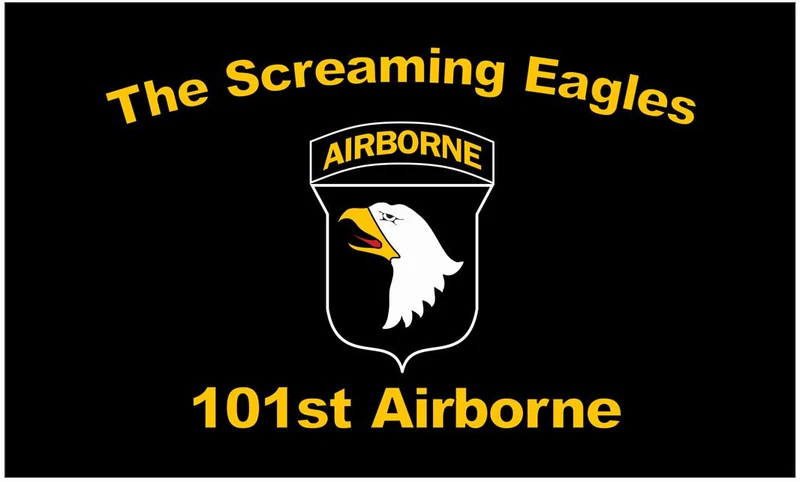
- The white eagle’s head is the centerpiece of the logo.
- As the national symbol of the United States, the eagle represents freedom, strength, and dominance of the skies.
- Its open beak (“screaming”) conveys aggression, readiness, and a fierce fighting spirit.
⚫ The Black Shield
- The black background symbolizes discipline, authority, and power.
- It also creates strong contrast, making the eagle highly visible and instantly recognizable.
- The shield shape represents protection and defense.
🟡 The Gold Border
- The gold outline stands for honor, excellence, and distinguished service.
- It highlights the division’s status as an elite unit within the U.S. Army.
The Number “101”
- While it identifies the division, “101” has become an iconic mark tied to its legendary combat history.
- Combined with the eagle, it forms a symbol that is widely recognized.
The Legend of “Old Abe”
The Story of “Old Abe”
“Old Abe” was a real bald eagle that served as the mascot of the 8th Wisconsin Infantry Regiment.
- In 1861, a Native American captured a young eagle and sold it to a local settler in Wisconsin.
- The eagle was later given to the regiment when they went off to war.
- Soldiers named it “Old Abe” after Abraham Lincoln.
An Eagle in Battle
What made Old Abe truly unique:
- It was not just a symbol—it was brought into battle with the troops.
- The eagle would perch on a stand or fly above the soldiers during combat.
- Its loud, piercing cries were believed to boost morale and inspire courage.
👉 Old Abe became a living symbol of bravery on the battlefield.
From Legend to Military Icon
After the war:
- Old Abe became widely recognized as a symbol of courage and American spirit.
- Its image lived on in military tradition.
When the 101st Airborne Division was formed in 1942:
- The division adopted an eagle’s head inspired by “Old Abe” → creating the now-famous “Screaming Eagle” emblem.
From Wisconsin to the World
The story of the 101st Airborne Division is deeply rooted in the state of Wisconsin, where its early identity and symbolism began to take shape.
Why the Eagle Was Chosen
After World War I, the division was initially associated with Wisconsin, a state rich in military tradition. To honor that heritage, it adopted imagery inspired by “Old Abe,” the legendary Civil War eagle.
By choosing this symbol, the division paid tribute to:
- The bravery and spirit of Wisconsin soldiers
- A historical legacy dating back to the American Civil War
- A uniquely American icon that already carried deep emotional meaning
👉 This decision connected the division to a proud past while shaping its future identity.
Transformation and Rise to Fame
During World War II, the division underwent a major transformation:
- It was reorganized into an airborne division, specializing in parachute and air assault operations.
- With this new role, it officially adopted the nickname “Screaming Eagles.”
This marked the beginning of its rise to global fame, as the division became known for:
- Rapid deployment behind enemy lines
- Elite training and discipline
- Outstanding performance in major battles
Becoming a Legend on Screen – Band of Brothers
The emblem of the 101st Airborne Division has long been a symbol of military excellence—but its reach expanded far beyond history through popular culture.
A Global Cultural Icon
Over time, the “Screaming Eagle” patch evolved from a military insignia into a globally recognized symbol.
Thanks to books, documentaries, and especially film and television, it came to represent not just a unit, but the broader ideals of:
- Courage under fire
- Brotherhood among soldiers
- Sacrifice and honor
👉 For many people around the world, the symbol is instantly recognizable—even without deep knowledge of U.S. military history.
The Impact of Band of Brothers
The turning point in modern popular culture came with the HBO miniseries Band of Brothers.
- The series follows the real-life story of Easy Company, a unit within the 101st Airborne Division during World War II.
- It portrays their journey from training to major battles such as D-Day and beyond.
- The show highlights their bravery, struggles, and deep bonds formed in combat.
Through its realism and emotional storytelling, Band of Brothers brought the “Screaming Eagle” symbol to a new generation.
The Story of Easy Company
At the heart of the series is Easy Company—ordinary men who became extraordinary through war.
- Their courage and resilience made them legendary.
- Their story turned the division’s insignia into something deeply human and relatable.
👉 The eagle patch became more than a badge—it became a symbol of brotherhood, sacrifice, and shared hardship.
The “Screaming Eagle” emblem of the 101st Airborne Division is more than just a military insignia—it is a powerful bridge across history.
From the legend of “Old Abe” during the American Civil War to the elite paratroopers of today, the image of the eagle has been carried forward as a living legacy—representing courage, fighting spirit, and honor.
It stands as a connection between a heroic bird of the 19th century and the modern warriors who continue that tradition.
This unique blend of history, symbolism, and emotion is what makes the emblem one of the most enduring and iconic symbols in American military heritage.