Among the many military symbols of the United States, the POW/MIA flag stands out as one of the most powerful and emotional. Unlike flags that represent victory or national pride, this flag represents something far more personal—loss, hope, and an ongoing commitment.
You may have seen it flying at government buildings, military cemeteries, or printed on shirts and patches. But what does it really mean?
What Does POW/MIA Stand For ?
POW/MIA is an abbreviation for:
- POW (Prisoner of War) – military personnel captured and held by enemy forces
- MIA (Missing in Action) – service members whose fate remains unknown
👉 Together, the term refers to those who never returned home and whose status remains unresolved.
At the heart of the flag is its defining message:
“YOU ARE NOT FORGOTTEN”
This phrase reflects a national promise to remember and account for every missing service member.
Historical Background: The Vietnam War Connection
The POW/MIA flag emerged during and after the Vietnam War, a conflict that left deep divisions in American society.
Following the war:
- Thousands of U.S. service members were listed as missing
- Many families believed their loved ones might still be alive
- The U.S. government faced criticism for a lack of transparency
In response, advocacy groups formed to demand answers, most notably:
National League of Families of American Prisoners and Missing in Southeast Asia
👉 This movement played a crucial role in raising awareness and ultimately led to the creation of the POW/MIA flag.
Who Designed the POW/MIA Flag?
The flag was designed in 1971 by: Newt Heisley
A Personal Story Behind the Design
- Heisley’s son had served during the Vietnam War and suffered severe health issues afterward
- The silhouette on the flag is widely believed to be inspired by his son’s appearance
👉 This personal connection gives the flag a deeper emotional meaning—it represents not just a national issue, but the pain of individual families.
Symbolism: What Each Element Represents
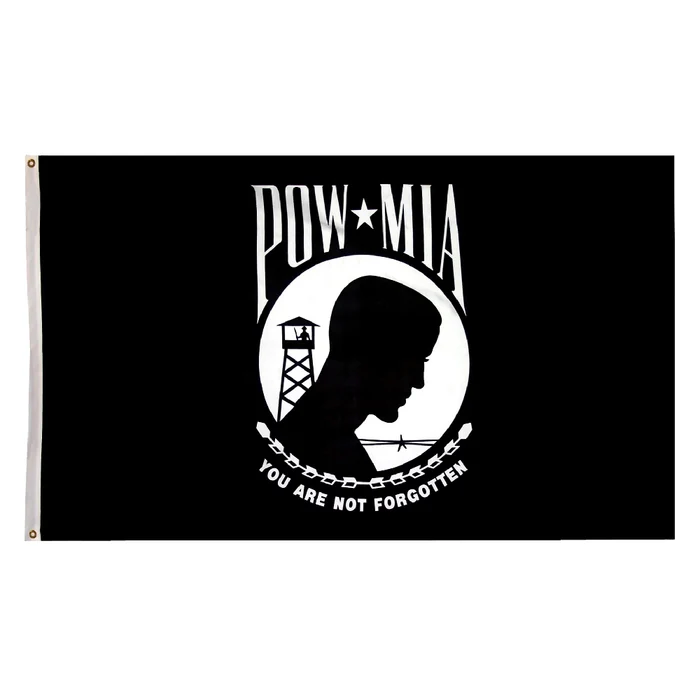
Although simple in design, every detail of the POW/MIA flag carries significance:
The Silhouette
A shadowed figure of a man
Represents all missing or captured service members
The lack of facial detail makes it universal—it could be anyone
Palm Tree and Guard Tower
- Suggest a prison camp setting in Southeast Asia
- Directly tied to the context of the Vietnam War
- The guard tower symbolizes surveillance and captivity
Barbed Wire
- A universal symbol of imprisonment
- Represents restriction, suffering, and loss of freedom
The White Star
- Symbolizes hope.
- Implies that some of the missing may still be alive.
Black Background
- Represents mourning, uncertainty, and remembrance.
- Sets a somber tone that distinguishes it from celebratory flags.
Official Recognition and Use
In 1990, the United States Congress officially recognized the POW/MIA flag as a national symbol.
It is one of the very few flags, besides the U.S. flag, that is regularly displayed at federal sites.
Where You’ll See the Flag
The POW/MIA flag is commonly flown at:
- The White House
- U.S. government buildings
- Military bases
- Veterans’ organizations
- National cemeteries
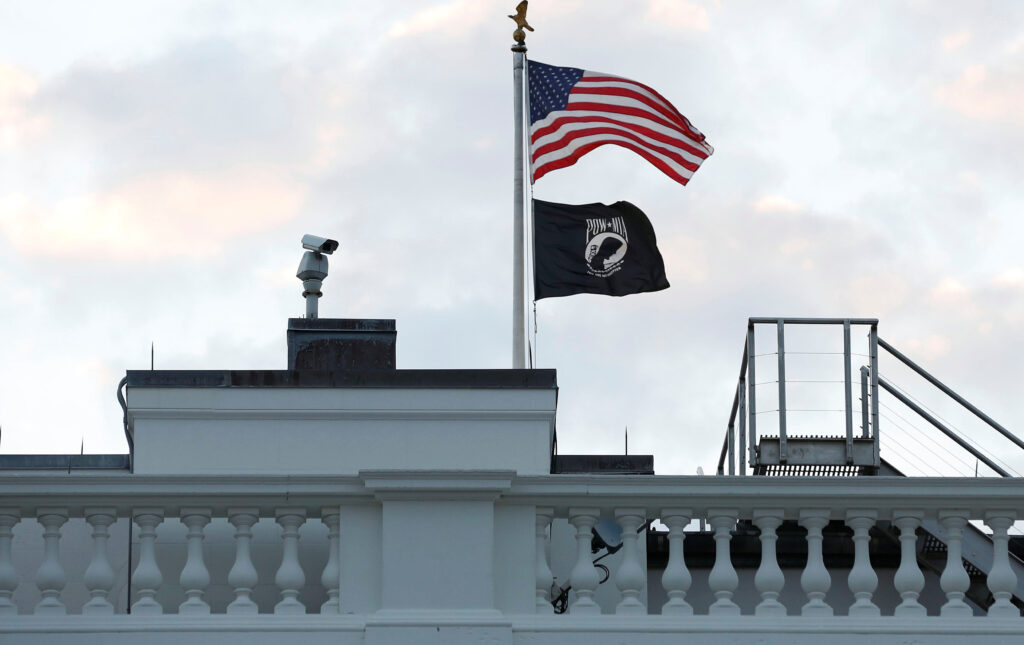
It is especially displayed on days such as:
- Memorial Day
- Veterans Day
- National POW/MIA Recognition Day
POW vs. MIA: Why the Distinction Matters
Although often grouped together, POW and MIA refer to different statuses:
| Term | Meaning | Status |
|---|
| POW | Prisoner of War | Captured and known to be alive (at least initially) |
| MIA | Missing in Action | Fate unknown |
Over time, some POWs were released, while others became unaccounted for. Many MIAs were later confirmed killed, but not all cases have been resolved.
Cultural Impact
The POW/MIA flag has extended beyond military use into American culture.
🎬 In Film
It appears in movies such as:
- Rambo: First Blood Part II
- Missing in Action
These films often explore themes of soldiers left behind and rescue missions.
🎖️ Among Veterans
The flag is widely used by:
- Military veterans
- Motorcycle clubs
- Patriotic communities
It frequently appears on:
- T-shirts
- Patches
- Stickers
- Tattoos
👉 For many, it represents loyalty to those who never made it home.
Deeper Meaning: A Promise That Still Stands
The POW/MIA flag is not about the past alone—it is about an ongoing commitment.
It serves as a reminder that:
- War does not truly end when fighting stops
- It ends only when every service member is accounted for
👉 Whether alive or fallen, every individual matters.
The POW/MIA flag is not a symbol of victory—it is a symbol of remembrance and responsibility. Its message, “You Are Not Forgotten,” reflects a promise that continues to resonate decades after the end of the Vietnam War.
In a world where history can easily fade, this flag stands as a powerful reminder that some stories are still unfinished—and some people are still waiting to be brought home.